Ice Maker Repair
Why Sub-Zero Cubes Turn Cloudy and Small Over a Hingham Season
Cloudy, hollow or undersized Sub-Zero cubes usually mean less water reached the mould than the cycle expected, and on the South Shore the change is often demand rather than a fault. How to read the bin, check the supply, and know when to call.
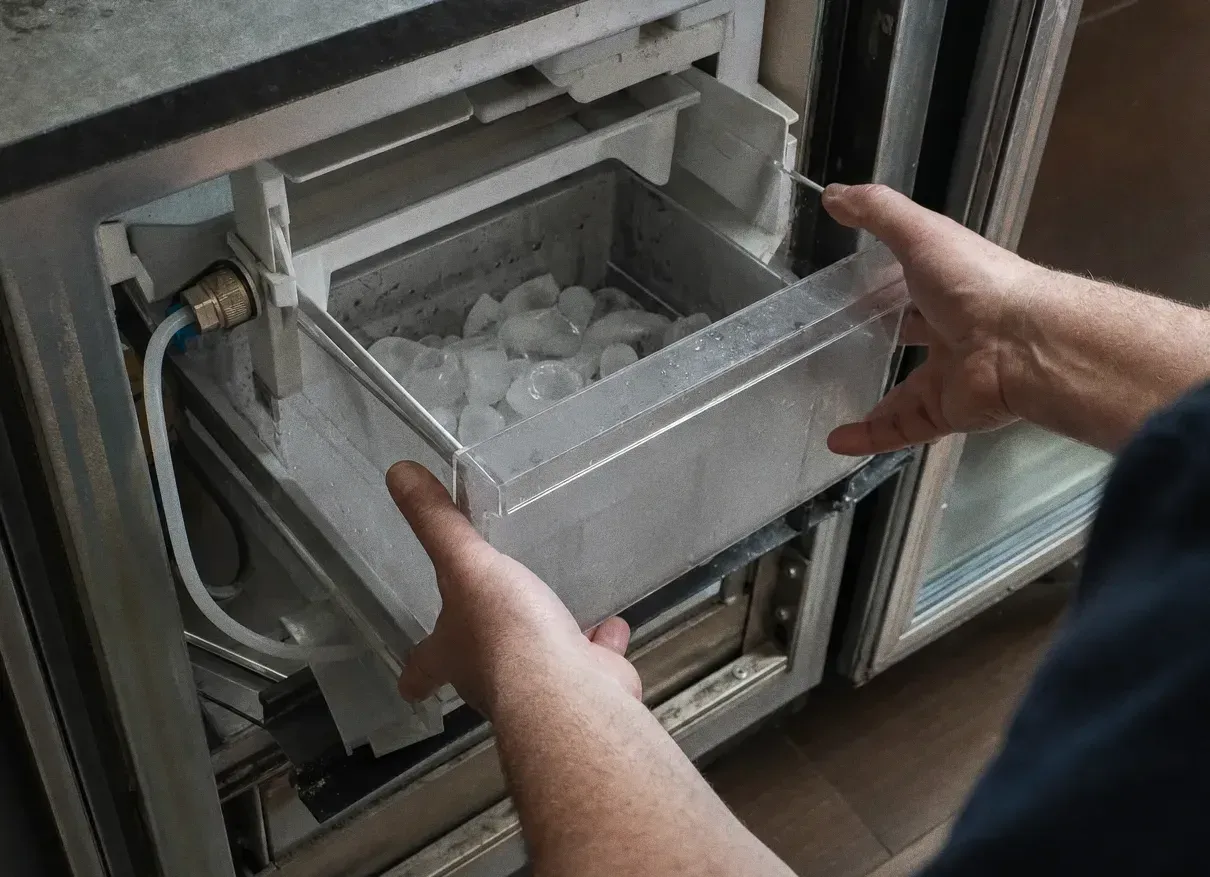
The bin already contains the diagnosis
Take a handful out and look at them before you look at the appliance. Where a cube comes out dished or hollow, the mould was given less water than the cycle called for. Cloudiness is dissolved air and minerals leaving solution as the water hardens. A slab that comes out in one piece is a release problem. Small but solid cubes are a fourth signal again, and none of these four point to the same place.
Hollow first, because it is the commonest. The mould filled short, froze what it was given, and ejected a shell. Cloudy cubes are a different matter entirely: they are what ordinary tap water looks like when it freezes fast, and clarity swings with the season and with the supply rather than with the health of the machine. Cubes fused into a block usually mean the bin has been sitting rather than emptying. Cubes that are simply smaller than they were, evenly, with no other change, are the one worth timing over a full day before doing anything at all.
That last case is the one we see most on the South Shore, and it is often not a fault. A Hingham household that runs quietly through February may double its draw the first warm weekend of the season, and a Hull or Cohasset house that fills with people from June onward asks a unit rated over a full day to supply a bin emptied in an afternoon. The machine has not slowed down. The demand in front of it has changed. Saying so plainly is more useful than selling a part.
The water side, checked before the machine
Follow the water back to where it starts before suspecting anything inside the cabinetry. A stop left part-open after a remodel, an old saddle fitting on copper, or a supply tube crushed where it passes the cabinet frame will all starve the fill. Restricted flow produces precisely the shell-shaped cube people describe on the phone, and it costs nothing to rule out.
Start with the valve nobody remembers touching. Kitchens in the Lincoln Historic District and along the streets off Main Street tend to have been rebuilt inside old ells, sometimes twice, and the shut-off ends up behind a panel or under a sink two rooms away. A stop that was closed for a plumbing job and reopened by feel is very often the whole story. Saddle valves are worse than useless here: they pierce a small hole, and that hole silts up.
Then the run itself. Norwell and Hingham houses frequently take the line through an unheated crawl space or the cold end of a basement, and a hard cold snap on that run does not have to freeze it solid to slow it. In Cohasset, where kitchens are often additions grafted onto older frames, clearance behind a panelled unit is measured in inches, and a tube that was fine on installation day gets pinched the first time the appliance is pushed back after service. If the cubes changed shape the same week something was worked on nearby, that is not a coincidence worth ignoring.
A saturated filter is a flow restriction
A loaded cartridge chokes flow well before it affects taste, which is why “the water still tastes fine” proves nothing. Flow is the first thing it takes and the last thing anyone notices. If the fill is short and the plumbing checks out, the cartridge is the next thing in the path and by far the easiest to change.
Aftermarket cartridges deserve a specific question rather than a general suspicion. Some flow perfectly well; others are built to a price and pass less water at the same supply pressure than the one they replaced. If the cubes changed shortly after a cartridge swap, the swap is the suspect. Running on bypass is a useful test with limits: if full cubes return on bypass, the restriction was the cartridge, but if nothing changes, all you have learned is that the restriction is somewhere else. It does not exonerate the machine.
On interval, resist the round number. Two households can put wildly different volumes through the same cartridge — a couple in Norwell and a Hull house sleeping nine in August are nowhere near the same schedule. So take the interval from the use and care guide for your own series, not from what a neighbour does.
When the fault is not in the ice maker at all
What the display shows you is the compartment’s set point; nothing on it is measured at the mould. Ice forms where the cold air actually arrives, and if the air is not arriving, freeze time stretches and the cubes come out wrong even though the display insists everything is fine.
Loading is the usual culprit. A compartment packed hard against its vents, with the bin buried behind a month of frozen stock, blocks the circulation the mould depends on. Leaving a hand’s width clear at the back and around the vents is a genuinely free fix, and it does more than most parts would.
Door habits matter more than people expect, and they matter honestly. Every opening admits warm, humid air that has to be pulled back out before production resumes. A quiet week produces good ice; a weekend with a screen door and a kitchen full of guests does not. If output recovers within a day or two of the house emptying, the appliance has been reporting the household, not a fault.
Harvest: making ice and letting go of it
Every cycle has two halves, and harvest is the second one. Water goes in, sets solid, and then a little warmth is applied to the mould — just enough to break the grip so an arm can sweep the cubes into the bin below. Making ice and letting go of it are two separate jobs, and they fail separately.
Cubes fused into a slab point at that second job or at simple turnover, not at freezing capacity. If the bin is barely used, cubes sit, sublimate at the surface and re-bond into a mass. If the bin empties daily and the slab still forms, the timing of the release is the thing to look at.
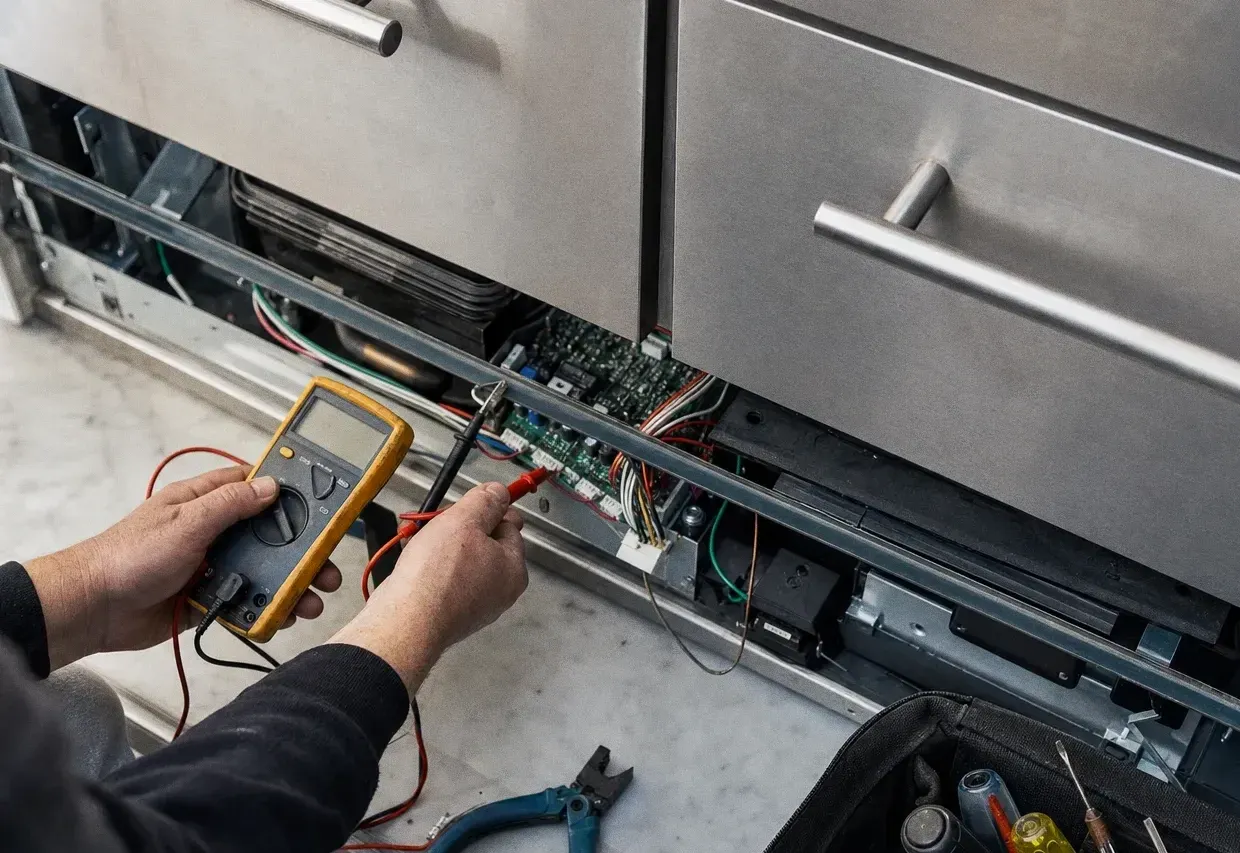
What you can observe without tools is worth writing down. Does the sweep run and stop? Does the sensing arm return to its rest position, or does it hang up on a cube that never cleared? Is there a fill sound at all? That is where a homeowner should stop. Beyond it are heaters, switches and a water valve carrying live circuits into a cold cabinet, and that work belongs on the Sub-Zero Ice Maker Repair page rather than on a kitchen counter.
What is worth calling about
Call when there is water on the floor, when a line is weeping at a fitting, or when the compartment itself will not hold its temperature. Those three are not ice problems, they are refrigeration problems wearing an ice problem’s clothes, and they get worse while you experiment with cartridges.
Call, too, when you have run out of things you can see. A technician measures what a homeowner cannot: how much water actually enters the mould, the pressure at the inlet with the valve open, and the timing of each stage of the cycle against what the control believes it is doing. Those three numbers usually settle the argument in one visit. The diagnostic call is $95, and where the fix lands in the ice maker, water valve or supply line, the work typically runs $300 to $710 depending on the part and the access.
We cover Hingham along with Cohasset, Norwell and Hull. There are two routes through to us and both sit at the top of this page: the number, or the booking link.
Still asked on the phone
Is it worth fitting a whole-house softener for this?
Softening changes what is dissolved in the water, and over time it may change how the cubes look and how much scale builds up. It will not fix a short fill, a restricted cartridge or a release fault, which are the causes behind most of the complaints we attend. Treat it as a water-quality decision for the whole house, taken with a treatment specialist, rather than as a repair for the ice.
Are hollow cubes always a water supply problem?
Usually, but not always. A shell means the mould held less water than the cycle expected, and the commonest reasons sit upstream: a part-closed stop, a silted piercing fitting, a pinched tube or a saturated cartridge. The other route to the same shape is a freeze that ended early, which points at the cycle rather than the plumbing. Check the water path first, because it is quicker and cheaper to rule out.
Does an aftermarket filter cartridge matter?
It can. A cartridge that fits perfectly may still pass less water at the same supply pressure, and the ice fill is the smallest and most flow-sensitive draw in the appliance, so it notices first. If the cubes changed shape within a few weeks of a cartridge swap, the swap is the leading suspect. Running on the bypass plug for a day will tell you whether that cartridge is the restriction.